Every family reunion has a shirt crafter, and this year it might be you. The design started as the family name. Then someone asked for the old farmhouse, a sunset and a color for each branch of the family tree.
That is often the moment crafters stop cutting vinyl and look at direct-to-film (DTF) transfers. A print shop puts the whole design on a film in full color, and you press it onto each shirt yourself. One Miami shop sells 9-color DTF transfers for vibrant merch, and a family crest works on them just as well as a company logo.

Which Method Suits a Many-Color Reunion Design?
Iron-on vinyl, also called heat transfer vinyl (HTV), comes in solid-color sheets. Every color is a separate layer. A four-color design means four cuts, four rounds of weeding, and several presses per shirt. Vinyl also cannot blend one shade into the next, so gradients and photos are out.
Screen printing needs a separate screen for each color. It pays off when dozens of shirts carry the same simple artwork, not when the art has many colors.
DTF sits between the two. The shop’s FAQ says multi-color designs print at the same time on a single sheet, with no screens or stencils to prepare. It also lists no minimum order. Its ORGB sheets add orange, red, green, and blue inks to the usual four. That helps with bold oranges and reds, like a farmhouse sunset.
Vinyl still wins for a one-color name across the chest. Some families skip printing altogether and turn a tie-dye shirt project into the first activity of the weekend.
How Do You Plan One Sheet for Every Size?
A reunion means kids, teens, and grandparents in one order. Plan the sheet around those sizes first.
- Ask for sizes with the RSVP. Put the size question on the invite when you plan a family gathering, so nobody guesses later.
- Sort the list into width groups. The shop’s size guide suggests a design about 9 to 9.5 inches wide for an adult small and 12 to 13 inches for a 4XL.
- Scale down for kids. Its youth chart runs from 7.5 inches wide for an extra-small to 8.5 inches for an extra-large.
- Add a small version. A 4-by-4-inch left-chest print suits polos for relatives who skip tees.
- Fill the width. Every ORGB sheet is 22 inches wide and sold by length, from 1 foot up to 8 feet or a custom size.
Order the shortest length first as a test. At the time of writing, the 12-inch length was listed at $7.20.
How Do You Press DTF Transfers Safely at Home?
These steps from the product page assume a heat press, not a household iron:
- Pre-press the shirt for 5 seconds to drive out moisture and wrinkles.
- Lay the transfer powder side down and cover it with a Teflon sheet.
- Press for 10 seconds at 300 to 310°F with firm pressure.
- Count 2 to 5 seconds, then lift the film while it is still hot.
- Press the bare design once more for 10 seconds.
For a first try or very fine lettering, the page suggests letting the print cool completely before peeling. Wait 24 hours before the first wash.
A press plate at 300°F is far hotter than any tap. Shriners Children’s says a deep burn takes less than one second at 150°F. It adds that 45% of contact burns in the past ten years happened to children under 5. Press after bedtime, or give little helpers the folding job across the room.
Which Shirts Can Take the Transfer?
Check the labels on your blanks against the product page’s fabric list.
| Blank or fabric | What the product page says | What to plan |
| 100% cotton and cotton blends | Compatible | Standard setting |
| 100% polyester, blends and tri-blends | Compatible | Test one spare first |
| Nylon and performance wear | Compatible at low heat | 260 to 275°F, 10 to 12 seconds |
| Denim and leather | Compatible | Test a scrap first |
| Coated or water-resistant fabric | Do not apply | Choose cotton instead |
| Sublimated jerseys | Do not apply, due to dye migration | Use plain blank jerseys |
| Highly elastic fabric | Do not apply | Skip stretchy leggings |
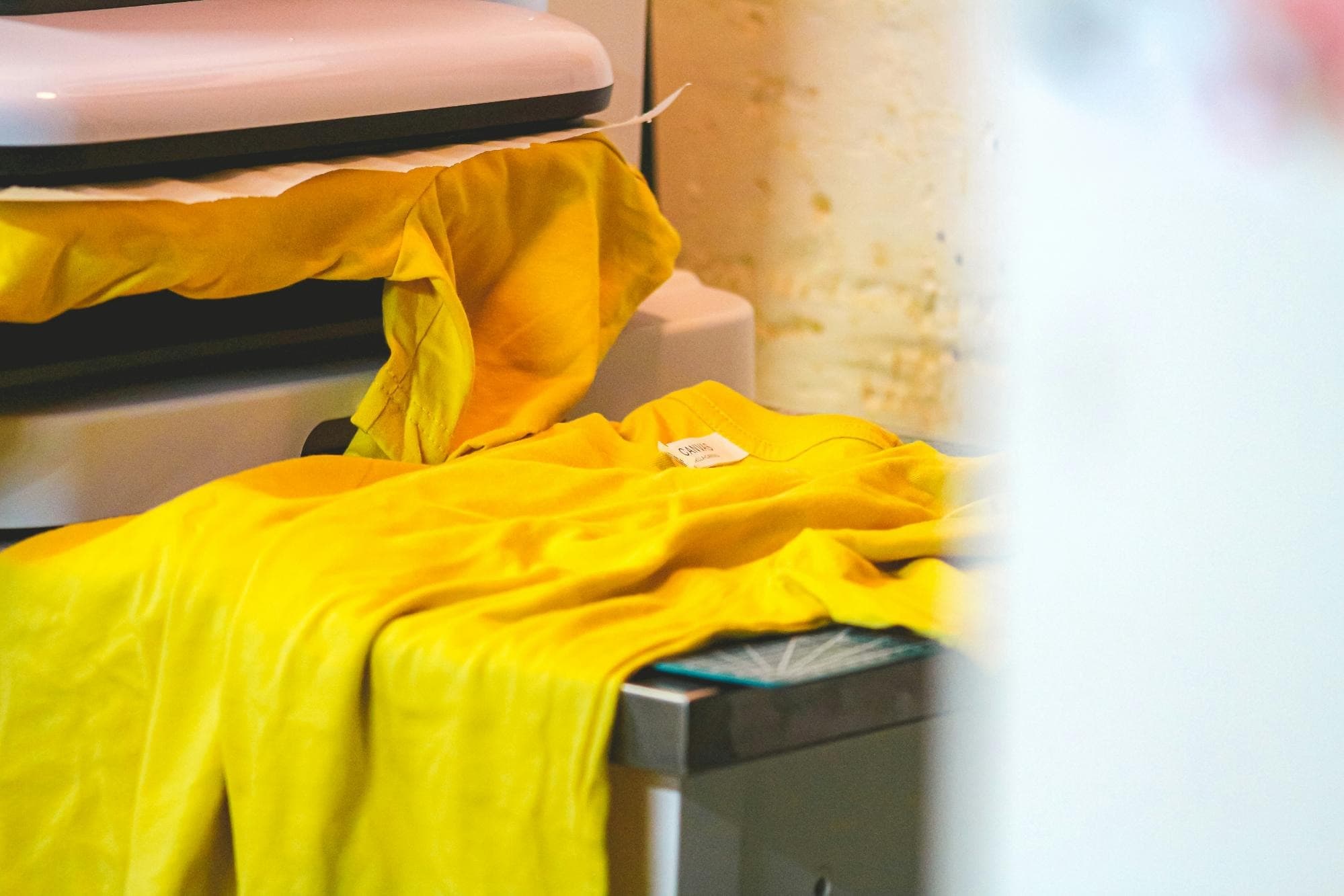
Photo by Compagnons on Unsplash
Alt text: A yellow T-shirt draped over an open heat press, with a second yellow shirt folded on the table below
Can You Print Grandma’s Photo On the Shirts?
A photo is often the heart of a reunion shirt, and the ORGB page says its system handles photographs well. Who took the picture still matters. In the US, copyright generally belongs to the person who took a photo, not the people in it.
Age can help with old photos. Cornell University Library’s chart, current as of 1 January 2026, says US works published before 1931 are in the public domain. Unpublished works are protected for the life of the author plus 70 years. A snapshot taken by a living aunt needs her blessing. A studio portrait may need the studio’s permission.
The print shop asks the same question. Its intellectual property policy says customers must hold all the rights needed for the designs they upload.
Before the Shirts Leave Your Dining Table
- Collect every size before you build the sheet.
- Press one test shirt before the full run.
- Allow 1 to 2 business days for production, plus UPS transit. The shop ships only within the United States.
- Tell relatives to wash shirts inside out in cold water, without fabric softener or high dryer heat.
Shirts That Show Up In Every Photo
A reunion shirt has one job: making a crowd of cousins look like one family in the group photo. Pick the method that suits your design, test one shirt, then press the rest with care.
Frequently Asked Questions
Can You Apply DTF Transfers With a Household Iron?
The shop’s pressing guide does not recommend it. It says an iron cannot hold even heat and pressure, so the print may peel in the wash.
Will the Design Fit Kids’ Shirts?
Yes, as long as the fabric is on the compatible list. The shop’s youth size chart suggests designs from 7.5 to 8.5 inches wide.
How Many Washes Will a Reunion Shirt Survive?
The shop’s pressing guide says prints last 50 or more washes when pressed correctly. It credits firm pressure, the final press, and a 24-hour wait before the first wash.
Can Relatives Outside the US Order the Same Transfers?
Not directly. The shop’s FAQ says it currently ships only within the US. A relative in the States can press extra shirts and bring them to the reunion.

- Why Wool Area Rugs Are the Smartest Choice for Busy Family Homes - November 19, 2026
- How Do Courts Treat Postpartum Depression Differently From Postpartum Psychosis During Divorce? - November 19, 2026
- What Should I Do if I Find a Potential Hazard in a Children’s Playground? - November 19, 2026