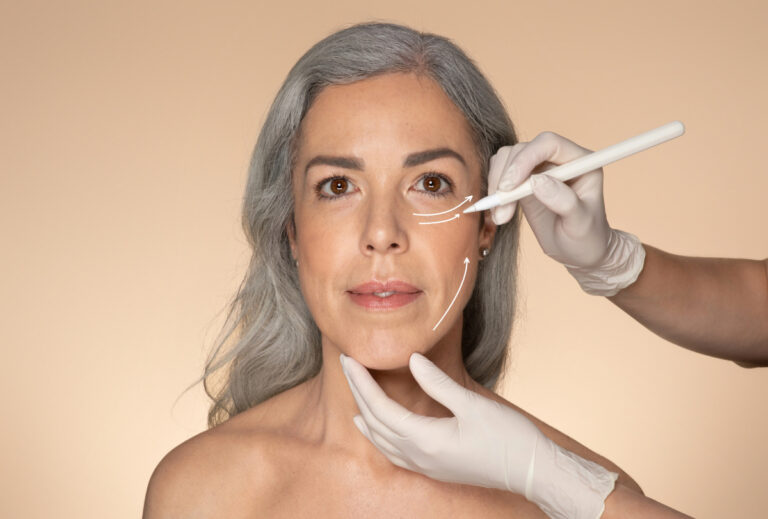
I don’t think collagen stimulators should replace fillers. I think the better question is whether the patient needs volume now, better tissue quality over time, or a combination of both.
That distinction becomes especially important with skin laxity. A patient who wants a sharper cheek contour before an event has a different clinical problem from someone whose face has gradually lost density, support, and elasticity over several years. Treating both patients with the same injectable because the products sit under the broad “filler” category is where treatment planning starts to get sloppy.
Immediate fillers and collagen-stimulating injectables solve different problems. Good aesthetic practice starts with accepting that.

Immediate correction has a place
Hyaluronic acid (HA) fillers are still hard to beat when the treatment objective is immediate contour correction. The gel provides volume where it’s placed, so a practitioner can address a hollow cheek, restore a deficient contour, or soften a fold during the same appointment. Some HA products also allow considerable control over projection, softness, and placement.
That predictability is useful.
It also gives HA fillers an important advantage when the patient’s timeline is short. If someone has an event in two weeks and wants a visible change, asking them to wait several months for collagen remodeling isn’t a sensible treatment strategy.
But immediate correction has limits. A filler can restore lost volume, yet it doesn’t automatically correct the broader decline in dermal support that accompanies aging. And if a practitioner keeps adding volume to compensate for worsening tissue quality, the face can eventually look heavier rather than younger.
This is where biostimulators become interesting.
Collagen stimulation asks for more patience
Sculptra, for example, uses poly-L-lactic acid (PLLA), a biodegradable synthetic material that works through a different mechanism from a conventional HA filler. Rather than relying on a preformed gel to create immediate volume, PLLA stimulates a tissue response that leads to gradual collagen production. The visible change develops over weeks and months rather than appearing fully formed on injection day. The FDA describes Sculptra as a dermal filler containing PLLA and has approved it for specific facial indications in appropriate patients.
That difference changes the consultation.
The patient has to understand that an early post-treatment appearance isn’t the final result. The practitioner also has to resist the temptation to judge the treatment too quickly. ASPS describes PLLA as a collagen stimulator whose results develop gradually, with treatment often involving multiple sessions.
For practices sourcing biostimulators, the product category itself deserves attention. Sculptra sits alongside other collagen-stimulating or skin-remodeling injectables, but these products aren’t interchangeable. Their materials, mechanisms, indications, injection approaches, and expected outcomes differ. For clinicians reviewing product options, wholesale pricing on Sculptra provides product information and purchasing details for licensed professionals, including the Sculptra formulation and its positioning as a PLLA biostimulator. It’s useful to review those details alongside the specific indication and treatment protocol being considered, rather than treating wholesale availability as a reason to choose one product over another.
The distinction is simple but important: the purchasing decision follows the clinical plan, not the other way around.

Skin laxity isn’t the same as volume loss
This is where consultations often become more nuanced.
A patient might describe their concern as “sagging skin,” but that phrase doesn’t tell you what has changed underneath. There could be loss of subcutaneous volume, reduced dermal thickness, laxity of the skin envelope, or a combination of these factors.
An injectable also has a ceiling. Fillers aren’t a substitute for surgical tissue repositioning in patients with substantial excess skin or advanced laxity. ASPS makes the same broader point in its guidance on dermal fillers, noting that fillers can restore fullness but don’t produce the same correction as procedures such as a facelift.
So before choosing an injectable, I’d separate the problem into three questions:
- Is there a structural volume deficit?
- Is the main concern skin quality and collagen support?
- Is the degree of laxity beyond what an injectable treatment can reasonably address?
The answers point toward different treatment strategies.
A practical way to choose
| Clinical situation | More logical starting point | Why |
| Definite volume loss with a need for immediate correction | HA filler | Provides predictable volume and contour |
| Diffuse age-related volume loss | Collagen stimulator | Gradual tissue remodeling can suit broader correction |
| Poor skin quality with mild laxity | Skin-quality or remodeling injectable | The goal is tissue quality rather than substantial projection |
| Patient wants visible change immediately | Immediate filler, where appropriate | The treatment timeline matches the expectation |
| Patient prefers gradual, less “filled” change | Collagen stimulator | Improvement develops progressively |
| Significant excess or advanced laxity | Surgical assessment | Injectable treatment has limited ability to reposition tissue |
This isn’t a rigid algorithm. Anatomy still wins.
A patient with mild laxity and good facial volume might benefit from a remodeling approach. Another patient with similar-looking laxity might first need restoration of a specific structural deficit. Two people can point to the same area in a mirror and need completely different treatment plans.
Don’t confuse collagen stimulation with skin hydration
There’s another distinction worth making, especially as the injectable market grows.
“Skin remodeling,” “skin boosting,” “biostimulation,” and “collagen stimulation” are sometimes used as though they mean the same thing. They don’t necessarily describe the same mechanism.
For example, Profhilo is a hyaluronic acid-based injectable designed around skin quality and bio-remodeling rather than conventional structural volumization. Its product information describes use in areas including the face, neck, and body, with treatment intended to improve skin characteristics rather than create the same type of contour as a traditional HA filler.
Sculptra is different again. Its active material is PLLA, and its clinical role is based on collagen stimulation and gradual structural improvement.
That doesn’t make one “better.” It means the practitioner needs to know what the product is designed to do before deciding where it fits in a treatment plan.
The selection mistakes I see most often
One mistake is choosing the product before defining the problem. Another is promising immediate results from a treatment designed to work gradually. This creates an expectation problem before the needle even comes out.
There’s also a tendency to compare products using longevity alone. “This lasts two years” sounds useful, but duration doesn’t tell you if the product is appropriate for the anatomy or correction being considered. A longer-lasting product isn’t automatically a better product for every patient.
And then there’s reversibility. Many HA fillers can be treated with hyaluronidase when clinically appropriate, while PLLA products don’t offer the same straightforward reversal mechanism. ASPS highlights reversibility as one of the practical advantages of HA fillers compared with non-HA biostimulators.
That matters during consent and treatment planning.
Patient selection matters more than the product label
Collagen stimulators aren’t appropriate simply because a patient asks for a “natural” result.
A proper assessment still needs medical history, examination of the treatment area, realistic expectations, and awareness of contraindications and precautions specific to the product being used. For Sculptra, FDA information lists hypersensitivity to components and certain severe allergy and abnormal scar histories among situations where the product should not be used.
Technique matters too. PLLA isn’t something to approach like a standard HA gel filler. Product preparation, injection plane, distribution, and aftercare all influence the risk profile and consistency of treatment. ASPS notes the importance of appropriate injection technique and even product distribution with polylactic acid products.
For clinic owners, this has a practical implication. Adding a biostimulator to the treatment menu isn’t simply a matter of stocking another syringe or vial. The team needs to understand the product’s indication, handling requirements, patient selection, consent process, and follow-up expectations.
The best treatment isn’t always the most immediate one
There are patients for whom immediate filler is exactly right. There are others for whom gradual collagen remodeling makes more sense. And some patients benefit from sequencing treatments rather than forcing one product to do everything.
I tend to think of immediate fillers as a precision tool and collagen stimulators as a longer-term tissue strategy. Neither deserves to win the argument universally.
The interesting part of aesthetic medicine is what happens before the injection. Once the practitioner has worked out whether the patient needs volume, remodeling, improved skin quality, or a surgical opinion, the product choice becomes much easier.
And sometimes the most useful decision is knowing when adding more volume isn’t the answer.

- A Coffee Date Built Around One Shared Card Game - October 6, 2026
- Holiday Prep With a Back That Keeps Complaining - October 6, 2026
- Crafting Peaceful Spaces: Soothing Touches for Home Decor - October 6, 2026